2024 Archbishop Gala for SHMS
By: Ken Warzybok -
Fri, Jun 7, 2024 6:45 AM
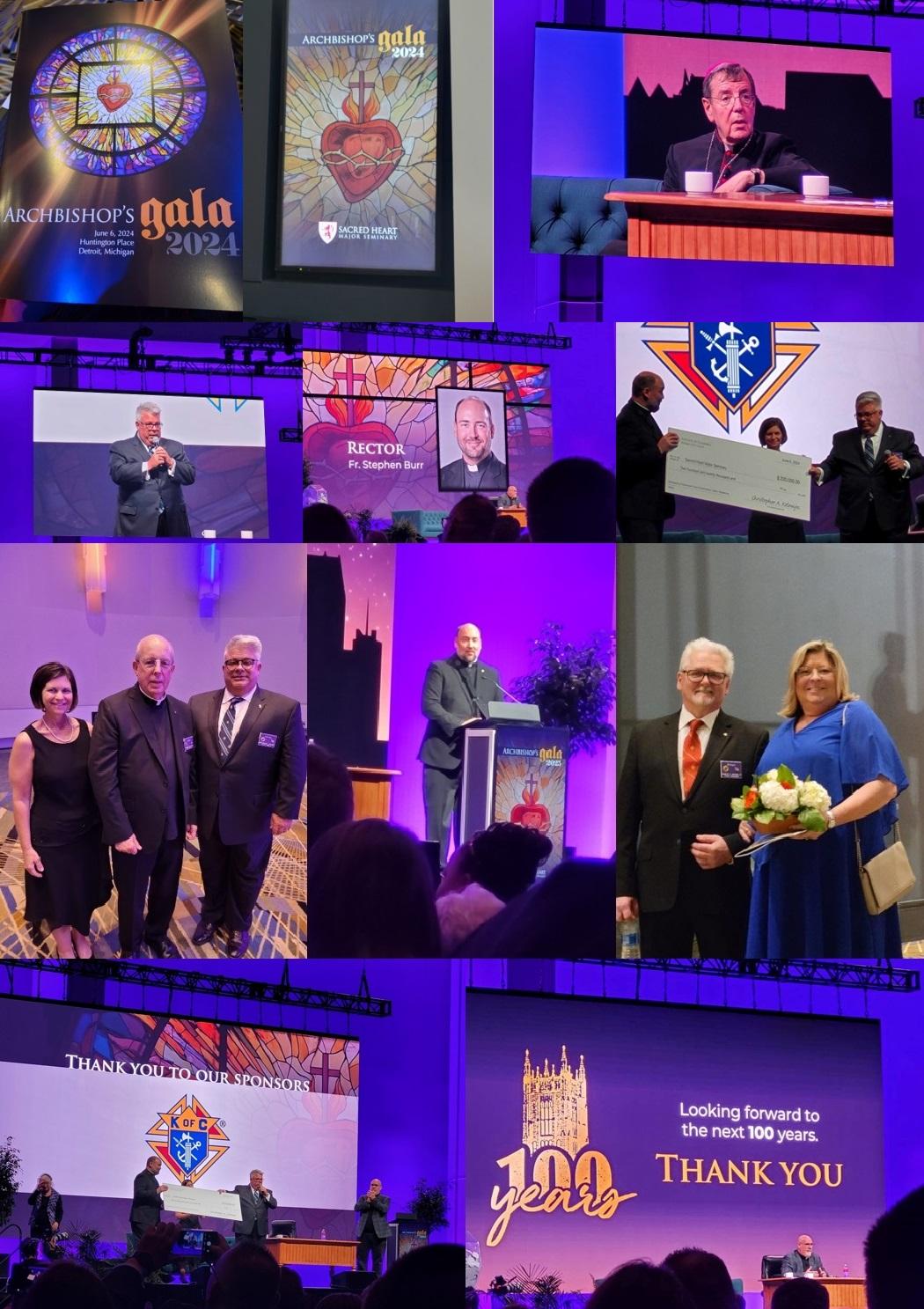
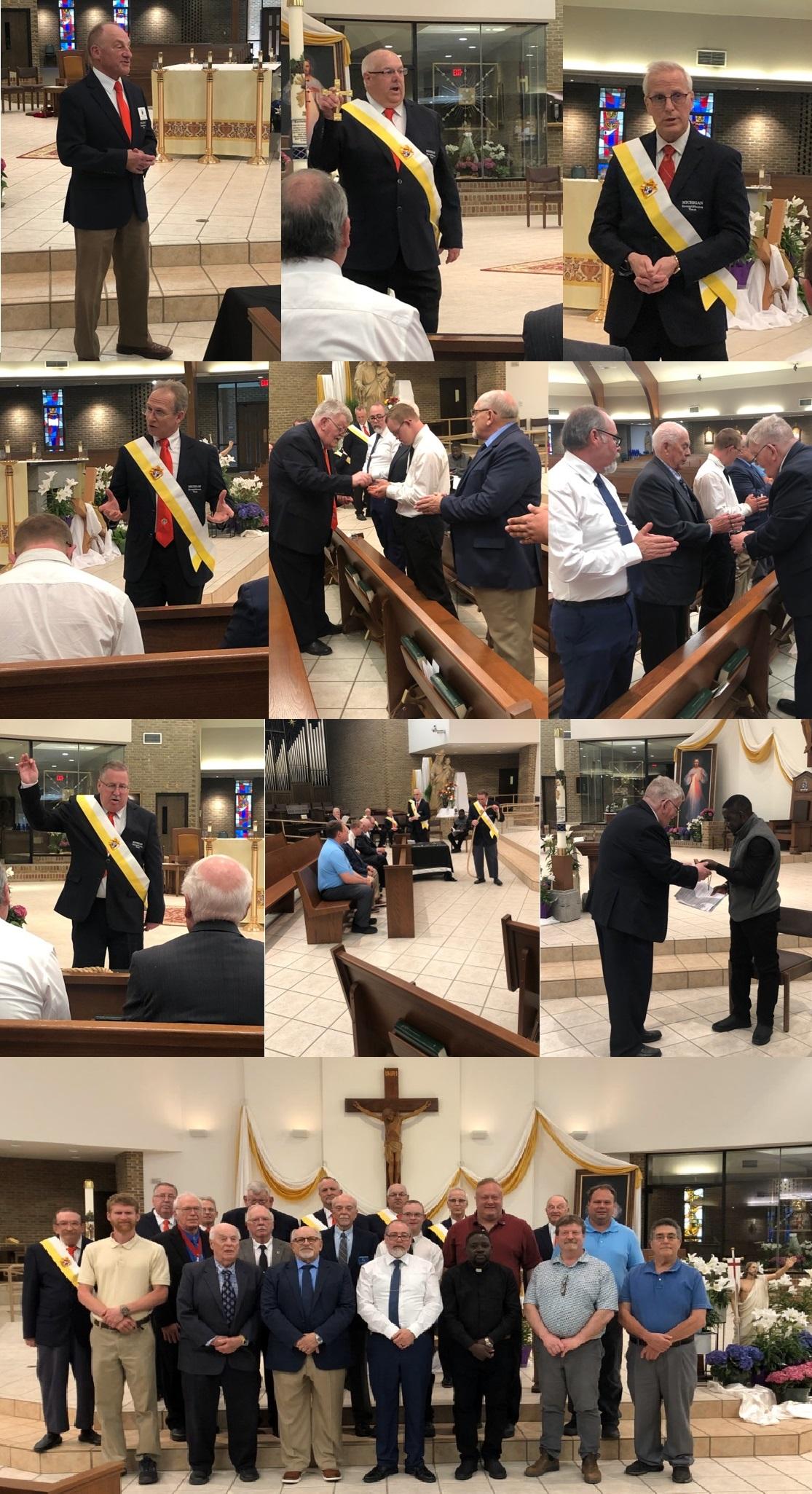
On June 6th, distinguished guests including patrons, seminarians, priests, and deacons convened at Huntington Place in downtown Detroit for the Archbishop’s Gala. The event was a resounding success, with attendees enjoying a memorable evening, including a $25,000 cash raffle generously donated by the Weingartz Family.
On behalf of the Michigan Knights of Columbus, State Deputy Christopher A. Kolomjec presented a generous donation of $220,000 from the Michigan K of C Endowed Scholarship Fund. This contribution will greatly benefit deserving students seeking higher education opportunities.
The Archbishop’s Gala is the largest fundraising event of the year for Sacred Heart Major Seminary, a renowned institution that plays a vital role in the formation and education of over 100 seminarians. These individuals are preparing for service in more than a dozen dioceses and religious communities. Additionally, the seminary provides education to hundreds of lay students, further enriching the community.
Thank you all for your support!
2024 Living Rosary at the State Capitol
By: Ed Strach -
Sun, Jun 2, 2024 8:03 AM
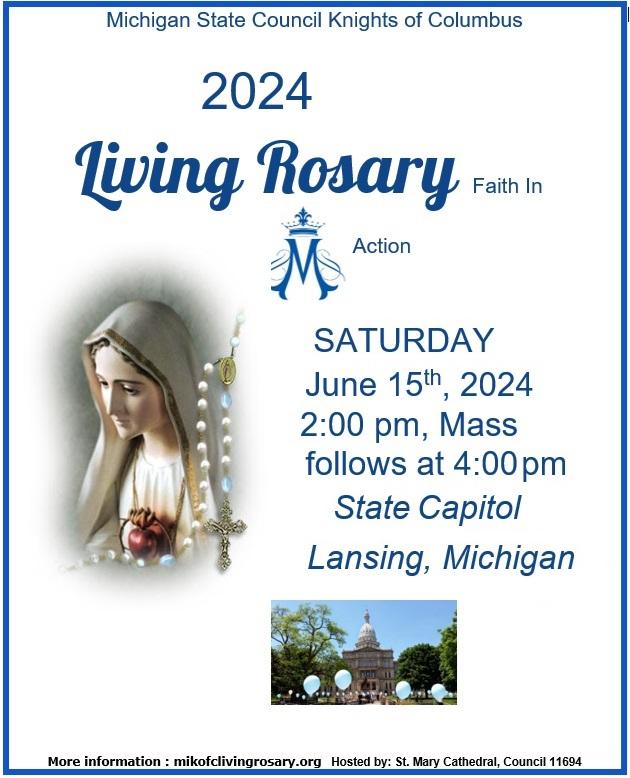
This year's Living Rosary is being held on June 15th, 2024 at 2:00 pm on the East Lawn of the Michigan State Capitol Building in downtown Lansing. Mass to follow at 4pm at St Mary's Cathedral. For more information,click here
2024 Living Rosary at the 2024 State Convention
By: Ken Warzybok -
Fri, May 24, 2024 10:15 PM
On May 23rd, 2024, Brother Knights and families gathered on the front lawn of the Grand Hotel on Mackinac Island. As one Family, United in Faith, they joyfully lifted their voices in devotion of the Most Holy Rosary.
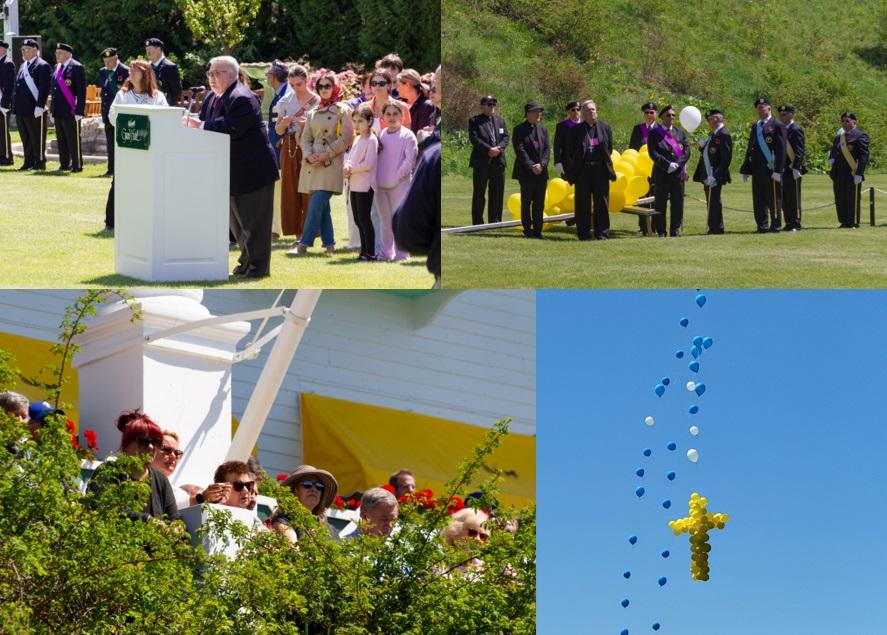
To view the video, click here
2024 MICHIGAN KNIGHTS OF COLUMBUS AWARD RECIPIENTS AT THE STATE CONVENTION
By: Ken Warzybok -
Fri, May 24, 2024 10:13 PM
2024 MICHIGAN KNIGHTS OF COLUMBUS AWARD RECIPIENTS
KNIGHT OF THE YEAR: State Membership Director Richard Shelt
COUPLE OF THE YEAR: Chief of Staff Cliff Wasmund and Lady Sue
MAN OF THE YEAR: State Director of Fraternal Activities Michael Kozakiewicz
WOMAN OF THE YEAR: Susan Wasmund
KNIGHTS OF COLUMBUS INSURANCE 2024 STATE AWARD WINNERS
State Treasurer Award: Timothy Messing (Huard Agency)
State Secretary Award: Brian Barlow (Huard Agency)
State Deputy Award: Brennan Hayden (Borrelli Agency)
DISTINGUISHED KNIGHT AWARD RECIPIENTS
Stan Politowicz, Grand Knight 13319
DD 112 Gary Mallia
DD 114 Daniel Timmerman
DD 517 Kevin Duffy
DD 604 William Perkis
Diocesan Program Director Joseph Langhauser
Diocesan Membership Director Wally Papciak
Diocesan Membership Director David Guenther
Diocesan Membership Director Hans Hansen
SDRR Martin Brown
SDRR Michael Prokopowicz
SDRR Paul Thorn
Training Director Matthew Wierzgac
State Faith Director Robert Bagley
State Community Director John Hundiak
State Cross Catholic Outreach Director Garret Kelenske
Chief of Training William LeVeque, Sr
Public Relations/Social Media Director Kenneth Warzybok
State Round Table Director Daniel Remeika
Immediate Past State Deputy Walter K. Winkle Jr
STATE PROGRAM SERVICE AWARDS
FAITH CATEGORY – Alfred E. Walters Council #3230/Ypsilanti. Grand Knight Jeffrey Kerner
FAMILY CATEGORY – Mason Council #9182. Grand Knight Charles March
COMMUNITY CATEGORY – Msgr O’Callaghan Council #649/Sault Ste Marie. Grand Knight Raymond Bauer
LIFE CATEGORY – Fr Thomas R. Carey Council #4764/Lake Orion. Grand Knight Thomas Tiffany
CHAPLAIN CATEGORY – Monsignor William Duncan, Pastor of St Sebastian Parish in Byron Center, and Vicar General/Moderator of the Curia
FAMILY OF THE YEAR – Ampe Family of Gwinn, MI
CONGRATULATIONS TO ALL OF OUR AWARD RECIPIENTS AND THANKS FOR ALL YOU DO!!
5 Things You Should Know About the Sign of the Cross
By: Robert Bagley -
Wed, May 8, 2024 7:02 AM
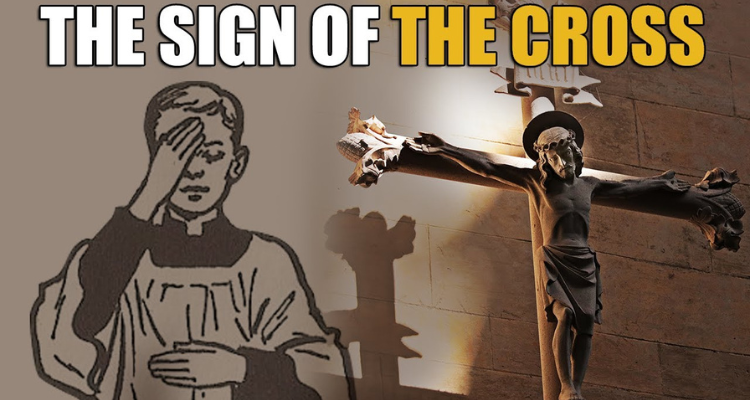
FIVE THINGS YOU SHOULD KNOW ABOUT THE SIGN OF THE CROSS
Each time we make the Sign of the Cross, we renew our profession of faith; express our belief in the Father, Son, and Holy Ghost; and acknowledge the divine work of creation, salvation, and sanctification. We invoke the Holy Trinity.
Never leave your house without making the sign of the cross. It will be to you a staff, a weapon, an impregnable fortress. Neither man nor demon will dare to attack you, seeing you covered with such powerful armor. Let this sign teach you that you are a soldier, ready to combat against the demons, and ready to fight for the crown of justice. Are you ignorant of what the cross has done? It has vanquished death, destroyed sin, dethroned Satan, and restored the universe. Would you then doubt its power?
1. The Sign of the Cross is a sacramental.
The Catechism of the Catholic Church recommends the practice of sanctifying our daily life with sacramentals, chief of which is the Sign of the Cross. Many Catholics don’t know that the Sign of the Cross is sacramental!
When we make the Sign of the Cross before we begin an activity, we elevate whatever it is we are doing. It becomes an opportunity for drawing nearer to God. Sacramentals are sacred signs that bear a resemblance to the sacraments. They signify effects—especially of a spiritual kind—that are obtained through the Church’s intercession and “are extremely powerful in our fight against the evil one.”
Other sacramentals are material, such as the Brown Scapular, Holy Water, liturgical or blessed candles, Holy relics or items such as crucifixes, medals, or rosaries. The Sign of the Cross is a sacramental gesture.
2. The Sign of the Cross should be made intentionally, never casually.
St. John Chrysostom said:
“When you sign yourself, think of all the mysteries contained in the cross. It is not enough to form it with the finger. You must first make it with faith and good will. When you mark your breast, your eyes, and all your members with the sign of the cross, offer yourself as a victim pleasing to God.”
The ritual of making the sign of the cross—if we aren’t careful—can become quick and sloppy. Every time we make the Sign of the Cross, in private or in public, we need to be attentive to what it is we are doing…Whether we are at Mass or in a restaurant it should be large and deliberate. Large because it is a witness to our faith and deliberate because it keeps our mind engaged on what we are doing.
3. The Sign of the Cross is rooted in ancient tradition.
It is clear from circumstances and from early Church fathers that the holy gesture of making the Sign of the Cross had its roots as a prayer in apostolic times. For instance, Tertullian, who lived from 160 – 240 A.D., said the following about the Sign of the Cross:
“At every forward step and movement, at every going in and out, when we put on our clothes and shoes, when we bathe, when we sit at table, when we light the lamps, on seat, in all the ordinary actions of daily life, we trace upon the forehead the sign.” Tertullian, 160 – 240 A.D.
And St. Basil (ca. 329 – 79 A.D) said that the Apostles “taught us to mark with the sign of the cross those who put their hope in the Lord,” that is, those who presented themselves for baptism.
Initially the Sign of the Cross was made with the thumb, usually on the forehead but sometimes on the lips and chest. This small Sign of the Cross was commonly used by the end of the 4th century and is still used today at every Mass and in the sacraments of Baptism, Confirmation, and the Anointing of the Sick. It is also used for marking the forehead with ashes on Ash Wednesday.
By the 6th century, people were using the first two fingers, held together to make a large sign of the Cross touching the forehead, chest, and shoulders. The two fingers symbolized the two natures (divine and human) of Jesus Christ.
The use of three fingers became popular in the 9th century, by which the thumb and first two fingers were held outstretched together to symbolize the Trinity, while the remaining two fingers were bent to signify the two natures of Christ. This form of the large cross is still used today in Eastern churches where the right shoulder is touched before the left.
4. The Sign of the Cross is a blessing.
A priest will make the Sign of the Cross when blessing someone, or a group of people, such as the congregation during Mass or other liturgical celebrations. However, many parents also bless their children with this ancient sign—and this is a good thing to do!
5. The Sign of the Cross is a weapon against the devil.
St. Athanasius wrote that before the coming of Christ, demonic powers used to deceive the pagans into worshipping them and obeying their oracles. “But now,” he observed in the fourth century, “since the divine appearance of the Word (Christ), all this deception has come to an end. For by the Sign of the Cross, if a man will only use it, their deceptions are driven out.” Knowing this, it is appropriate to make the Sign of the Cross whenever we are feeling spiritually attacked. The devil hates this sign, so we wield a spiritual power when we use it.